Hyperscaler FDE Units: How AWS, Microsoft and Google Cloud Embed Engineers With Customers
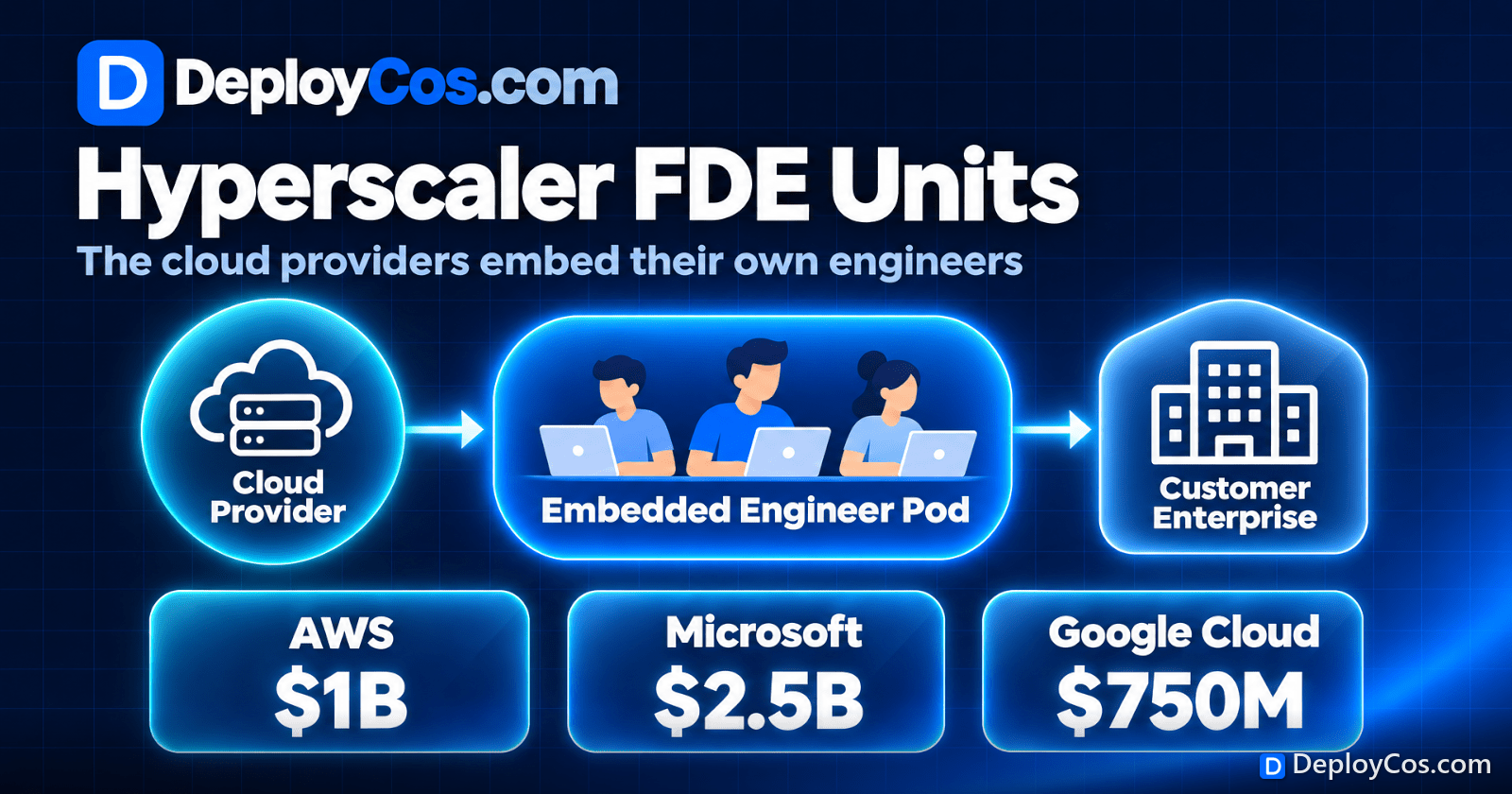
The three largest cloud providers answered the 2026 DeployCo launches with forward deployed engineering of their own. AWS committed $1 billion to a Forward Deployed Engineering unit on 06-30-20261, Microsoft followed two days later with the $2.5 billion Microsoft Frontier Company45, and Google Cloud had already folded embedded forward deployed engineers into a $750 million partner fund in April6. This page compares the three units: the money, the people, the method, the pricing, and how a hyperscaler unit differs from a lab-backed or independent DeployCo.
DeployCos.com is an independent reference and is not affiliated with Amazon, Microsoft or Google.
Three hyperscalers, three models
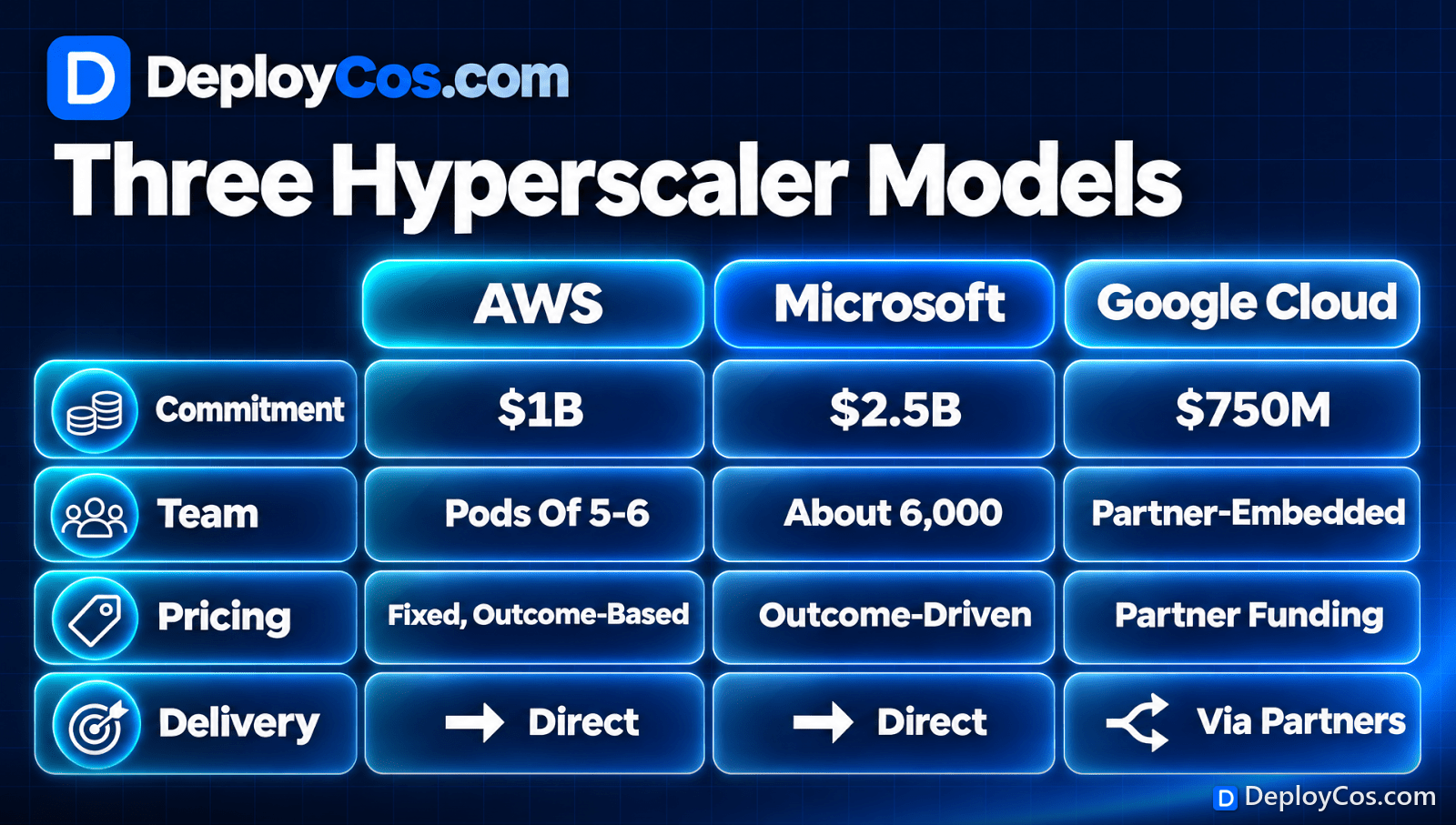
All three units put engineers inside customer organizations to take AI from prototype to production, and all three are paid for by the cloud provider itself. They differ in who does the work: AWS and Microsoft deliver directly with their own engineers, while Google Cloud embeds its engineers alongside systems integrators and funds partners to do most of the delivery.
| AWS | Microsoft | Google Cloud | |
|---|---|---|---|
| Unit | Forward Deployed Engineering | Microsoft Frontier Company | Embedded FDEs within a partner fund |
| Announced | 06-30-20261 | 07-02-20264 | 04-22-20266 |
| Commitment | $1 billion1 | $2.5 billion4 | $750 million6 |
| People | Pods of five or six engineers per customer; reported as "hundreds" and as "thousands" of engineers at launch12 | About 6,000 industry and engineering experts45 | 59 open FDE roles in May 2026; FDEs are "not new" at Google Cloud7 |
| Leader | Francesca Vasquez, VP Frontier AI Engineering and Services1 | Rodrigo Kede Lima, president of Microsoft Asia4 | Not a separate unit; the fund sits with the Global Partner Ecosystem team6 |
| Pricing | Fixed, outcome-based, not billable hours1 | Not disclosed; described as "outcome-driven"5 | Not disclosed; partner funding and usage incentives6 |
| Delivery | Direct, with partners complementary1 | Direct, with Accenture among launch partners5 | Through partners, with Google FDEs embedded alongside6 |
| Named early customers | Allen Institute, Cox Automotive, NFL, NBA, Ricoh12 | LSEG, Unilever, Land O'Lakes45 | Not named; Zebra Technologies quoted as a Gemini Enterprise user6 |
AWS Forward Deployed Engineering
AWS announced its Forward Deployed Engineering unit on 06-30-2026 with a $1 billion commitment that covers scaling the engineering team, market development funds, cash and credit investments, and partner allocations1. It is led by Francesca Vasquez, VP of Frontier AI Engineering and Services, and is funded entirely from AWS's own balance sheet12. The Next Web reported it as the first hyperscaler commitment to an FDE unit at this scale2.
The engagement model is the most detailed of the three. Engineers work in pods of five or six, each embedded with one customer at a time, alongside the customer's business, engineering and security teams2. AWS packages the pace as "AI 45": 45 minutes to an idea, 45 hours to a prototype and about 45 days per engagement, varying by use case1. Pricing is fixed and outcome-based rather than billed by the hour, and every engagement is designed to end with an exit strategy so the customer can run the system itself1. AWS says it will use enterprise-wide semantic context and ontology in "probably almost all" engagements to keep agents consistent1.
Early customers named in coverage include the Allen Institute, Cox Automotive, the National Football League, the National Basketball Association and Ricoh, with regulated industries such as financial services, healthcare and the public sector next12. AWS describes the unit as complementary to its partners and says it expects to work with the FDE arms of both Anthropic and OpenAI12.
The launch also drew the sharpest public skepticism of the year. Constellation Research CEO R "Ray" Wang said at the launch: "I'm tired of looking at fake FDEs," and Constellation noted it was not yet clear whether AWS's engineers would combine technical and business depth the way Palantir's do1. See Forward Deployed Engineers for that debate.
Microsoft Frontier Company
Microsoft announced the Microsoft Frontier Company on 07-02-2026, two days after AWS, as a $2.5 billion operating business of about 6,000 industry and engineering experts who work alongside customers to build, launch and keep improving AI systems at scale345. Judson Althoff, CEO of Microsoft's commercial business, announced it and positioned it as more than an FDE team: "This goes beyond what has been labeled as Forward-Deployed Engineering," he wrote, saying it "will be the largest, most capable, outcome-driven engineering organization in the industry"5.
HCAMag reports that Rodrigo Kede Lima, president of Microsoft Asia, leads the company, and that its focus is what Microsoft calls "Frontier Transformation"4. Launch partners named in coverage are the London Stock Exchange Group, Unilever, Land O'Lakes and Accenture5. In the LSEG example, Microsoft's engineers and industry experts embedded AI into LSEG Workspace so finance professionals can get answers from structured and unstructured financial content4. Althoff also said customer data is not used "to train models in ways that commoditise what differentiates them"4.
Microsoft has not published pricing, a delivery method or a headcount breakdown. The 6,000 figure is the largest stated FDE-style workforce of any 2026 entrant, but Microsoft has not said how many of those people are new hires rather than existing staff assigned to the company.
Google Cloud's partner-led approach
Google Cloud announced a $750 million fund on 04-22-2026 at its Next conference in Las Vegas to help partners in its 120,000-member ecosystem move joint customers' agentic AI projects into production6. The fund covers AI value identification, prototyping, agent building and deployment, upskilling, and teams of embedded Google forward deployed engineers6. Google will embed those engineers alongside Accenture, Capgemini, Cognizant, Deloitte, Devoteam, HCLTech and TCS to support deployments and resolve difficult technical problems6.
Nine AI-native services firms are launching Gemini Enterprise practices under the program: Altimetrik, Artefact, Covasant, Deepsense, Distyl, Northslope, Quantium, Tribe.ai and Tryolabs6. Two of them sit elsewhere on this site: Distyl is an independent DeployCo, and Northslope agreed to be acquired by the OpenAI Deployment Company in July 2026 (see DeployCo Companies).
Google Cloud CEO Thomas Kurian followed in May 2026 with a hiring call for more forward deployed engineers "to help us scale customer AI transformation," noting that "having FDEs is not new for Google Cloud"; CIO Dive counted 59 open FDE roles in the US, London, Paris and Hong Kong, with applied AI FDE base salaries of $127,000 to $183,000 in New York and Atlanta7. Google has not announced a standalone unit or a headcount target.
How hyperscaler units differ from DeployCos
A hyperscaler unit is a third shape alongside the lab-backed and independent DeployCos described in Types of DeployCos. The differences that matter to a buyer:
- Funding and ownership. The OpenAI Deployment Company and Ode were set up with private equity partners; the three hyperscaler units are funded internally with no outside investors125.
- What is being sold underneath. A lab-backed DeployCo pulls through its parent's models. A hyperscaler unit pulls through cloud consumption, and AWS and Google Cloud both offer models from several labs, so the unit can be more model-neutral while still tied to one cloud.
- Channel conflict. Every hyperscaler depends on systems integrators. AWS calls its unit complementary to partners, Microsoft launched with Accenture, and Google routes most of its money through partners156. How work is split when a hyperscaler pod and an integrator want the same project is not public.
- Pricing. AWS is the only one of the three, and one of the few 2026 entrants, to state fixed, outcome-based pricing1. See DeployCo vs Consulting vs SaaS.
For questions to put to any of these units before signing, see How to Evaluate a DeployCo; the exit-plan and lock-in questions matter most when the partner also runs the cloud.
Frequently asked questions
Which hyperscaler has the largest FDE unit?
Is the Microsoft Frontier Company a separate company?
It is described as a new operating business inside Microsoft, funded by Microsoft with no outside investors, rather than a joint venture like the OpenAI Deployment Company or Ode5.
What is AWS's "AI 45" method?
AWS's shorthand for its pace: 45 minutes to an idea, 45 hours to a prototype and about 45 days per customer engagement, varying by use case1.
Does Google Cloud have a forward deployed engineering unit?
References
- Constellation Research, "AWS launches forward deployed engineering unit with $1 billion investment," 06-30-2026. constellationr.com
- The Next Web, "AWS commits $1bn to forward deployed engineers for enterprise AI," 06-30-2026. thenextweb.com
- TechRadar, "Microsoft is spending $2.5bn on deploying AI engineers to its customers," 07-2026. techradar.com
- HCAMag, "Microsoft invests $2.5 billion to help companies embed AI at work," 07-06-2026, citing Microsoft's 07-02-2026 blog post. hcamag.com
- TechBriefly, "Microsoft backs Frontier Company with 2.5 billion dollars," 07-03-2026. techbriefly.com
- HPCwire (Google Cloud press release), "Google Cloud Commits $750M to Accelerate Partners' Agentic AI Development," 04-22-2026. hpcwire.com
- CIO Dive, "Google Cloud is hiring an army of AI deployment engineers," 05-14-2026. ciodive.com