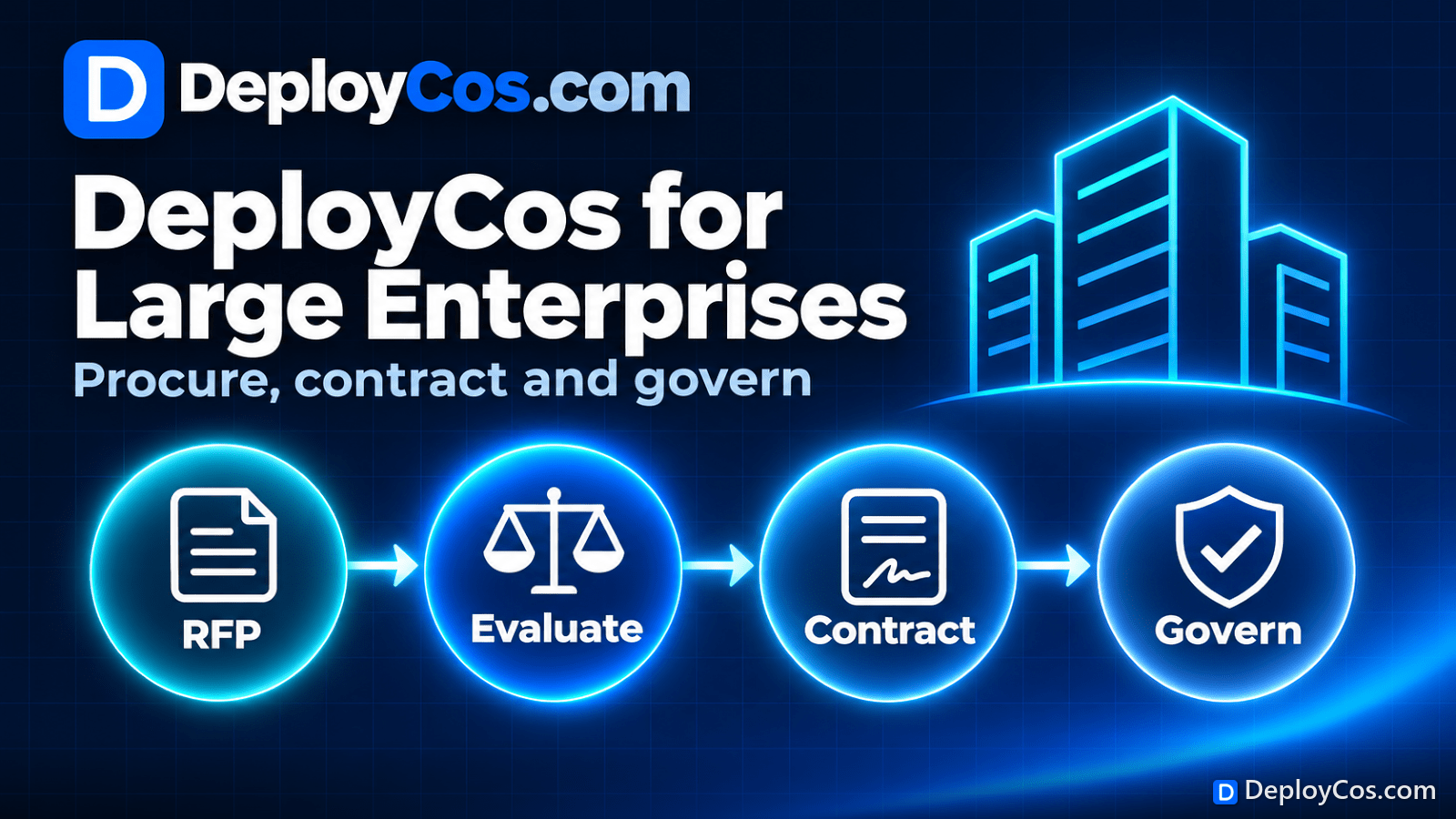
DeployCos for Large Enterprises: Procurement, Contracts and Governance for Fortune 500 Buyers
For a large enterprise, the hard part of hiring an AI deployment company is not the build; it is procurement, security review, contract terms and running several vendors at once. The verdict: run a competitive diagnostic with at least two provider types, write model portability, data use, IP ownership and exit into the contract before any build starts, and keep an internal owner for every workflow. This page is the procurement, legal and risk view.
The procurement path
- Request for information to four to six providers across types: lab-backed, hyperscaler, independent and integrator. Use the RFP question bank (60 questions).
- Shortlist two of different types for a paid, fixed-price diagnostic of two to four weeks each.
- Score the diagnostics with the weighted vendor scorecard: ranked workflows, evidence for the model choice, production unit cost, team quality.
- Contract the first workflow on the statement of work template, with acceptance tied to performance in production.
- Govern with a monthly steering review and the KPI dashboard.
Contract terms that matter
| Term | What to get | Why |
|---|---|---|
| Data use | No training on your data unless you opt in, in the contract itself | Help pages and blog statements are not contractual1 |
| Definitions | Customer data, output data, training data and derived data defined separately | Ownership depends on which category a file falls into1 |
| IP ownership | You own code, prompts, evaluation sets, configurations and fine-tuned weights; perpetual license to vendor components | The harness and the evaluations are the durable assets |
| Model portability | The system must run on an alternative model with notice | Protects against price changes, deprecation and lock-in |
| Acceptance | Statistical performance on an agreed evaluation set, in production, for a set period | AI outputs are probabilistic; "delivered" is not "working" |
| Exit | Data, prompts, embeddings and artifacts returned in usable formats; transition assistance priced in advance | Exit terms are cheapest to negotiate at signing2 |
The U.S. federal government's acquisition rules for AI point the same way: OMB memorandum M-25-22 asks agencies to bar vendors from training on non-public government data without consent and to address knowledge transfer, data and model portability and pricing transparency to avoid lock-in2. The full list of clauses to catch is in the contract red flags cheat sheet.
Running several providers at once
Large enterprises rarely pick one. A common pattern is a systems integrator for the change program, a DeployCo or hyperscaler unit for engineering on specific workflows, and an internal platform team that owns shared components: identity, logging, evaluation tooling and the model gateway. Keep those shared components in-house so each new provider plugs into your foundations rather than bringing its own. Watch for conflicts: McKinsey, Bain & Company and Capgemini are investors in the OpenAI Deployment Company, and Accenture, Deloitte and PwC are in Anthropic's partner network3.
Tools and downloads for enterprise buyers
Start with the comparison matrix and the readiness checklist.
DeployCo Vendor Scorecard
Weighted scorecard for comparing lab-backed, hyperscaler, independent and consulting options. Weights are editable and the totals recalculate.
Deployment ROI Model
The ROI calculator as a spreadsheet: payback, 3-year net present value and DeployCo vs internal build, with every assumption in one place.
RFP and RFI Question Bank
60 questions to send AI deployment vendors, grouped by team, diagnostic, workflow, security, IP and data, pricing and exit.
Statement of Work Template
Editable SOW for a DeployCo engagement: phases, acceptance criteria, IP and data clauses, staffing, handover and exit.
Executive Briefing Deck
Ten slides on what DeployCos are, who the players are, the risks and the decision in front of you.
Board One-Pager
The case for and against engaging an AI deployment company in the next 12 months, on one page.
First 90 Days Playbook
Week-by-week plan for the buyer side of a first engagement, from kickoff to the day-90 review.
Cheat Sheet: Contract Red Flags
Twelve clauses and gaps to catch before you sign an AI deployment contract.
Questions enterprise buyers ask
Can we use our existing cloud commitment?
Often, with a hyperscaler unit: AWS, Microsoft and Google Cloud tie their programs to their platforms, and partner funding or credits may apply. Confirm in writing what counts toward your commitment.
How do we handle security review for embedded engineers?
Treat them like any privileged contractor: scoped credentials, named individuals, logged access and a non-production environment for building. Start the review before kickoff, because it is the most common cause of delay.
Should procurement insist on fixed price?
Fixed price for the diagnostic, yes. For the build, fixed or outcome-based pricing is available from some providers (AWS states it publicly); otherwise cap time and materials and tie a holdback to acceptance.
Who should own the relationship internally?
A business owner for the metric and a technical owner for the system, with procurement and legal as gatekeepers. A vendor managed only by procurement drifts toward scope expansion.
Are regulated industries different?
The terms are the same but stricter: data residency, sub-processor lists, audit rights and sector rules must be settled before data moves. Ask which regulated customers the provider already serves in production.
References
- Venable LLP, "Practical Tips for Reviewing AI Service and AI-Related Agreements," 01-12-2026. venable.com
- PilieroMazza, "OMB Issues Memoranda on Use and Acquisition of AI by Federal Agencies, Part 2." pilieromazza.com
- OpenAI, "OpenAI launches the OpenAI Deployment Company," 05-11-2026. openai.com; Anthropic, "Building a new enterprise AI services company," 05-04-2026. anthropic.com; see How to Evaluate a DeployCo.