DeployCo Readiness Checklist: 40 Checks Before You Hire an AI Deployment Partner
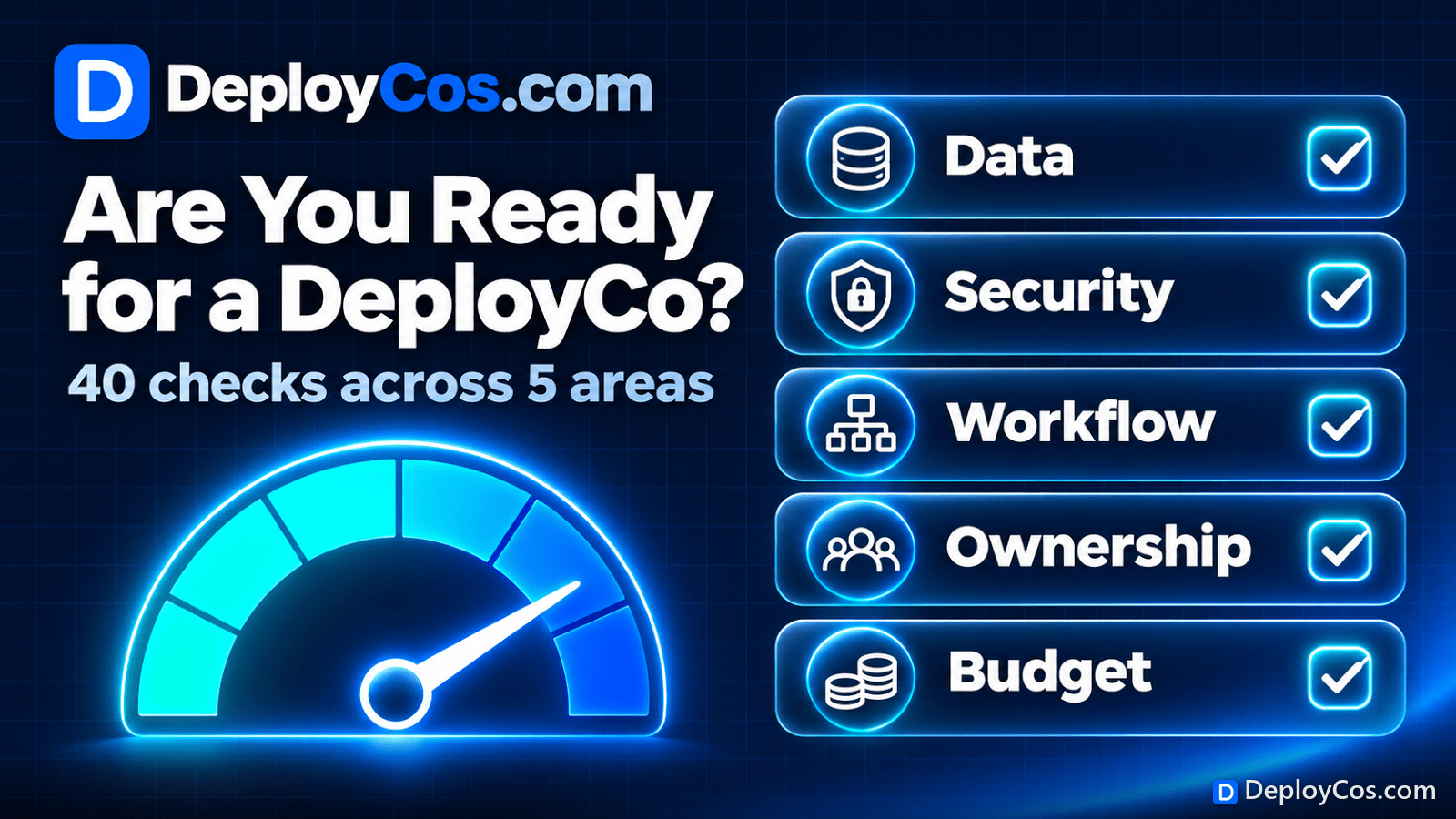
Most stalled AI engagements stall for reasons the buyer controls: no data access in week one, no baseline metric, no owner after handover, security and contract terms left to the end. Tick the 40 items that are true today across five areas. You get a live score, a score per area and a verdict on what to do next. Your ticks stay in your browser, and the page prints as a clean checklist.
The checklist
What your score means
| Score | Verdict | Next step |
|---|---|---|
| 0 to 15 | Not ready yet | Fix data access, ownership and the first workflow before you sign |
| 16 to 25 | Partly ready | Start a paid diagnostic; write the gaps into the statement of work |
| 26 to 33 | Ready for a pilot | One bounded workflow, a baseline and a fixed test set |
| 34 to 40 | Ready to scale | Several workflows, with a plan to take them over |
A low score in one area matters more than the total. A team scoring 7 of 8 everywhere except security will still stall at the security review. Fix the weakest area first.
Where the checks come from
The items follow the five evaluation criteria and the questions in How to Evaluate a DeployCo, the delivery models in How DeployCos Work, and published contracting guidance for AI services: no training on customer data by default, explicit IP and data-ownership terms, and exit and portability provisions negotiated at signing12. AWS designs its engagements to end with an exit plan so the customer can run the system itself3.
Next: compare providers in the matrix, model the economics in the ROI calculator, and send the RFP question bank.
Frequently asked questions
What is the most common readiness gap?
Data and system access. Embedded engineers build on your systems of record; if credentials, environments and approvals take a month, the engagement pays for a month of waiting. Start access requests before kickoff.
Do we need all 40 before we start?
No. A score in the mid-20s is enough for a paid diagnostic, as long as the gaps are named in the statement of work with an owner and a date.
Can I save or share my results?
Your ticks are saved in your browser automatically. Use Print or save as PDF to share a copy; the print view drops the site navigation and buttons.
References
- Venable LLP, "Practical Tips for Reviewing AI Service and AI-Related Agreements," 01-12-2026. venable.com
- PilieroMazza, "OMB Issues Memoranda on Use and Acquisition of AI by Federal Agencies, Part 2" (memorandum M-25-22, 04-2025). pilieromazza.com
- Constellation Research, "AWS launches forward deployed engineering unit with $1 billion investment," 06-30-2026. constellationr.com