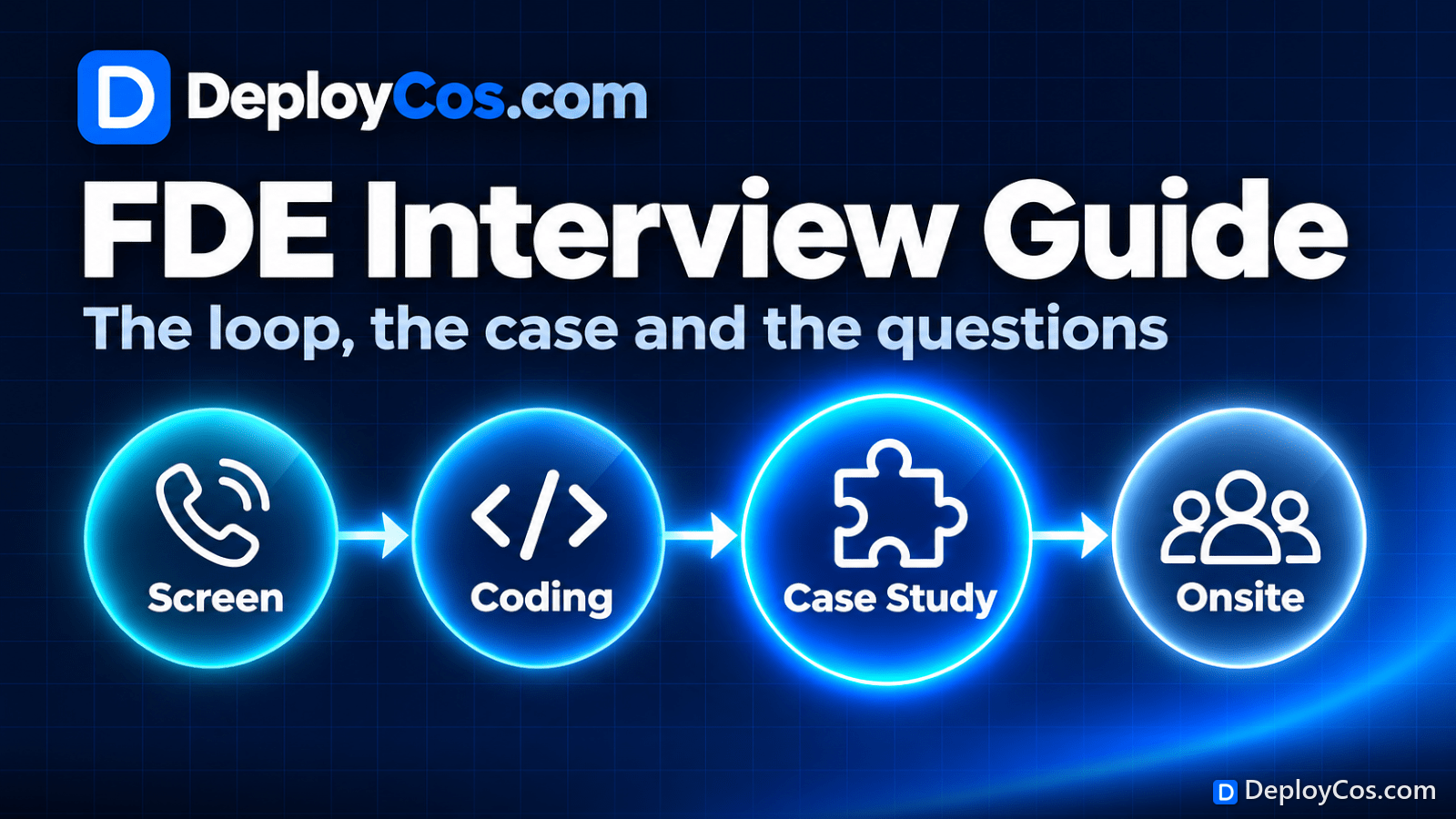
Forward Deployed Engineer Interview Guide: The Loop, the Decomposition Case and 30 Sample Questions
Forward deployed engineer interviews test two things: can you ship production code, and can you take an ambiguous customer problem and turn it into a plan? The second is where most candidates fail. This guide sets out the loop by employer type as reported in published guides and candidate accounts, the round that decides most outcomes, and 30 representative questions. Employers rarely publish their loops, so treat the details as reported, not official.
The typical loop
- Recruiter or hiring-manager screen - background, motivation, travel and customer appetite.
- Coding - live coding or an online assessment, often framed around an end-user feature or an API task.
- Technical deep dive - a past project, data pipelines, or system design.
- Decomposition or customer case - an ambiguous business problem you break down out loud. Reported as the heaviest-weighted round.
- Behavioral and values - pushback, ambiguity, failure and working without authority.
Published prep guides describe this five-stage shape across employers, with total timelines of three to six weeks1.
Loops by employer type (reported)
| Employer | Reported loop | Distinctive round |
|---|---|---|
| Palantir | Recruiter call; live coding or online assessment (coding, SQL, an API task); three onsite rounds from decomposition, learning, coding, re-engineering and system design; hiring-manager round. About 3-4 weeks, no take-home2 | Decomposition, which most candidates fail |
| OpenAI | Recruiter screen, technical coding assessment, decomposition case study, hiring-manager conversation. About 3-5 weeks3 | Decomposition case, with customer empathy and business judgment weighted heavily |
| Anthropic | Guides disagree (five stages vs seven or eight rounds). One describes a Python screen, a take-home or extended build, a customer-conversation simulation and a virtual onsite1 | Customer simulation; not confirmed by Anthropic |
| Hyperscalers (AWS, Microsoft, Google Cloud) | No loop with rounds has been published; the units are new in 2026 | Not documented |
| AI-native startups | Screen, coding assessment, coding interview, then a case where a hypothetical customer presents a problem (reported for ElevenLabs)1 | Customer mock-up |
How to handle the decomposition round
- Clarify the goal and the user. Who has the problem, and what would "fixed" look like to them?
- Ask about the data. What exists, where it lives, how good it is.
- Break the problem into parts and say which you would tackle first and why.
- Propose something shippable in week one, then the path to the full solution.
- Name the risks and how you would measure success.
Interviewers are watching how you think under ambiguity, not whether you reach a particular answer. Talk through trade-offs, and change course when they give you new information.
30 sample questions
Representative prompts drawn or paraphrased from published guides124. They show the style of each round; they are not confirmed as asked by any one employer.
Coding
- Implement shape classes that compute area, then extend them for a new shape.
- Fetch paginated data from a REST API, handling page size and total pages.
- Solve a string or array problem framed as an end-user feature, then discuss edge cases.
- Implement a feature, then refactor it for readability and reuse.
- Extend your solution for a new requirement a user might request.
- Find and fix a double-counting bug in a function that tallies values in a hash map.
- Debug a program modeling spread across a social graph that returns the wrong count.
- Read provided modules and enhance them using a documented library.
Data and SQL
- Write a SQL query that joins and aggregates tables to answer a business question.
- A pipeline you shipped is writing duplicate records to the customer's warehouse. How do you find the cause?
- Design an ingestion layer for a customer with 12 data sources and no clean schema.
System design
- Design components, data flow and APIs for a real operational problem, and walk through trade-offs.
- Design a sync system between two employee record systems.
- Design a way for several teams to query a shared dataset without exposing the raw data.
- Compare hosted and self-hosted model deployment for a regulated customer.
- Stage a rollout so the customer sees value in week one, not month six.
- Design a multi-tenant deployment of a large language model for many customers.
Customer case and decomposition
- Design a system to improve traffic in a large city.
- Design an application to catalog species while exploring an unfamiliar environment.
- A customer says their dashboard is wrong but cannot say which number. What do you do?
- A logistics company asks why deliveries are late. Where do you start?
- A hospital has patient records in six systems. How would you give a nurse one view?
- An operations team "can't trust the dashboard." Find out what is wrong and propose a plan.
- A third-party API in a customer integration starts timing out intermittently. Debug it.
Behavioral and customer-facing
- A customer demands a feature you know will not solve their problem. What do you do?
- Explain embeddings to a vice president of operations who has never written code.
- Tell me about a time you pushed back on a customer request.
- Why this company, and why this team?
- Describe a project that failed and what you changed afterward.
- A buyer says your model does nothing a competitor's cannot. Respond.
Skills employers list most
Production Python plus JavaScript or TypeScript; retrieval, agents and evaluations; a cloud model platform (Bedrock, Azure OpenAI or Vertex AI); SQL and data pipelines; problem decomposition; and communication from engineers to executives. Several postings mention travel of up to half the time3. Build them in order with the learning roadmap.
Frequently asked questions
How long does an FDE interview process take?
Published guides report three to six weeks from first call to offer, with some candidates reporting long waits for a decision at Palantir.
Is the FDE interview harder than a software engineering interview?
The coding bar is similar. The difference is the decomposition or customer round, which software engineering loops usually lack and which reportedly decides most FDE outcomes.
Is there a take-home?
Palantir's loop is reported without one. Some guides describe a take-home or extended build at Anthropic. Ask the recruiter at the start.
How should I prepare for the customer round?
Practice decomposing open business problems out loud, and prepare five stories: cross-functional work, ambiguity, a failed project, a technical disagreement and impact without authority.
References
- Perspective AI, "Forward Deployed Engineer Interview Questions: 2026 Prep Guide." getperspective.ai
- Aced (formerly Exponent), "Palantir Forward Deployed Engineer Interview." aced.io
- Paraform, "OpenAI Forward Deployed Engineer." paraform.com
- TechInterview.org, "Forward Deployed Engineer Interview." techinterview.org