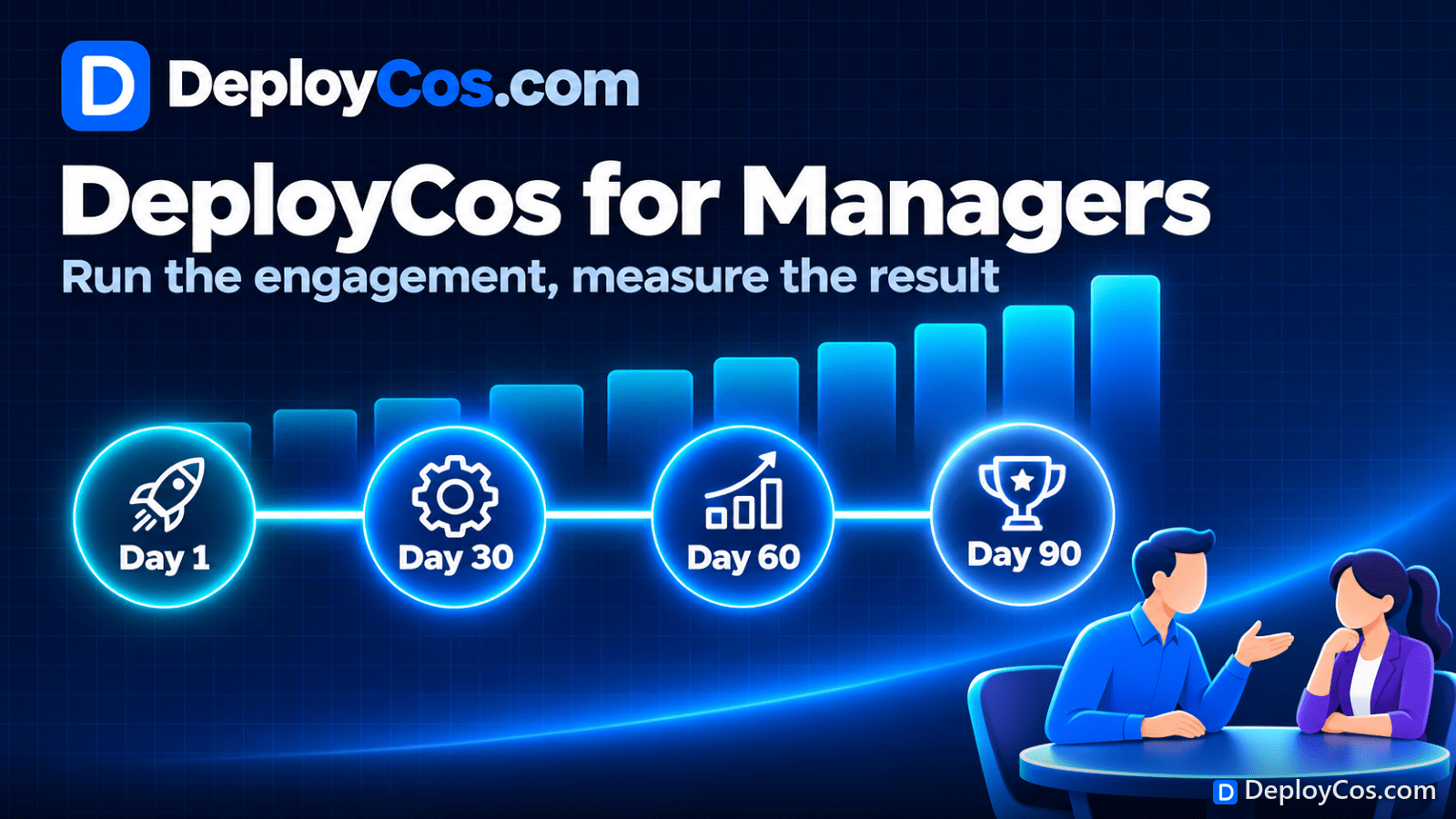
DeployCos for Managers: Running an AI Deployment Engagement and Measuring the Result
Engineering, program and operations managers run the engagement day to day. The verdict: success is decided by three things you control - a baseline measured before the build, your subject experts' time budgeted every week, and a weekly cadence that surfaces blockers fast. This page is the manager's playbook: the 90-day plan, the metrics to track and the people side of putting AI into a team's work.
The 90-day plan
| When | Your job |
|---|---|
| Before day 1 | Signed scope with acceptance criteria; named sponsor, business owner and technical owner; access requests started; baseline measured |
| Weeks 1-2 | Kickoff with the people who do the work; access granted by day 10; evaluation set agreed |
| Weeks 3-4 | Prototype reviewed on real data; model choice recorded; security review started |
| Weeks 5-8 | Shadow mode alongside staff; tracing and cost monitoring in place; internal owner trained |
| Weeks 9-12 | Go-live bar met; staged rollout; weekly metric against baseline |
| Day 90 | Decide: scale, fix or stop; confirm handover date |
The full week-by-week version is the First 90 Days Playbook.
Metrics to track
- Workflows in production, not pilots.
- Straight-through rate and escalation rate: how much the system completes alone, and how often it hands to a person.
- Accuracy on the evaluation set, refreshed monthly.
- Cycle time and cost per task against the baseline.
- Embedded engineer hours, which should fall as your team takes over, and internal engineers trained.
Track them monthly in the KPI dashboard.
The people side
The people who do the work today know the exceptions no document records. Bring them in from the first week, give them time to review outputs, and say plainly what will happen to the hours the system frees up. Teams that hear about automation from a vendor demo resist it; teams that help define the cases tend to own the result. Budget subject-expert hours every week, and protect them.
Tools and downloads for managers
Use the decision tool to frame the choice of provider, and the ROI calculator to set expectations.
DeployCo Vendor Scorecard
Weighted scorecard for comparing lab-backed, hyperscaler, independent and consulting options. Weights are editable and the totals recalculate.
Deployment ROI Model
The ROI calculator as a spreadsheet: payback, 3-year net present value and DeployCo vs internal build, with every assumption in one place.
Engagement KPI Dashboard
Monthly tracker for adoption, cycle time, cost per task, accuracy, escalation rate and engineer hours per workflow.
Statement of Work Template
Editable SOW for a DeployCo engagement: phases, acceptance criteria, IP and data clauses, staffing, handover and exit.
First 90 Days Playbook
Week-by-week plan for the buyer side of a first engagement, from kickoff to the day-90 review.
Cheat Sheet: FDE vs SE vs SA vs Consultant
How a forward deployed engineer differs from a sales engineer, a solutions architect and a consultant.
Cheat Sheet: Contract Red Flags
Twelve clauses and gaps to catch before you sign an AI deployment contract.
Cheat Sheet: First-Meeting Questions
The fifteen questions to ask in the first vendor meeting, and what a good answer sounds like.
Questions managers ask
How much of my team's time will this take?
Plan for subject experts to spend several hours a week on discovery, labeling examples and reviewing outputs, more in the first month. Put the number in the statement of work so it is planned, not borrowed.
What does a good weekly update contain?
Progress against the plan, the metric against baseline, risks and the decisions needed from you, on one page.
When should we stop an engagement?
When the evaluation score is not converging toward the go-live bar by mid-engagement, or when cost per task cannot meet your ceiling. A good partner will raise it first.
How do we keep the skills after the partner leaves?
Pair an internal engineer with the provider from week one, keep the code in your repositories and schedule the handover date at the start.
What if staff push back?
Involve them in defining the cases, let them correct the system, and be honest about what changes in their roles. Resistance usually means they were not consulted.