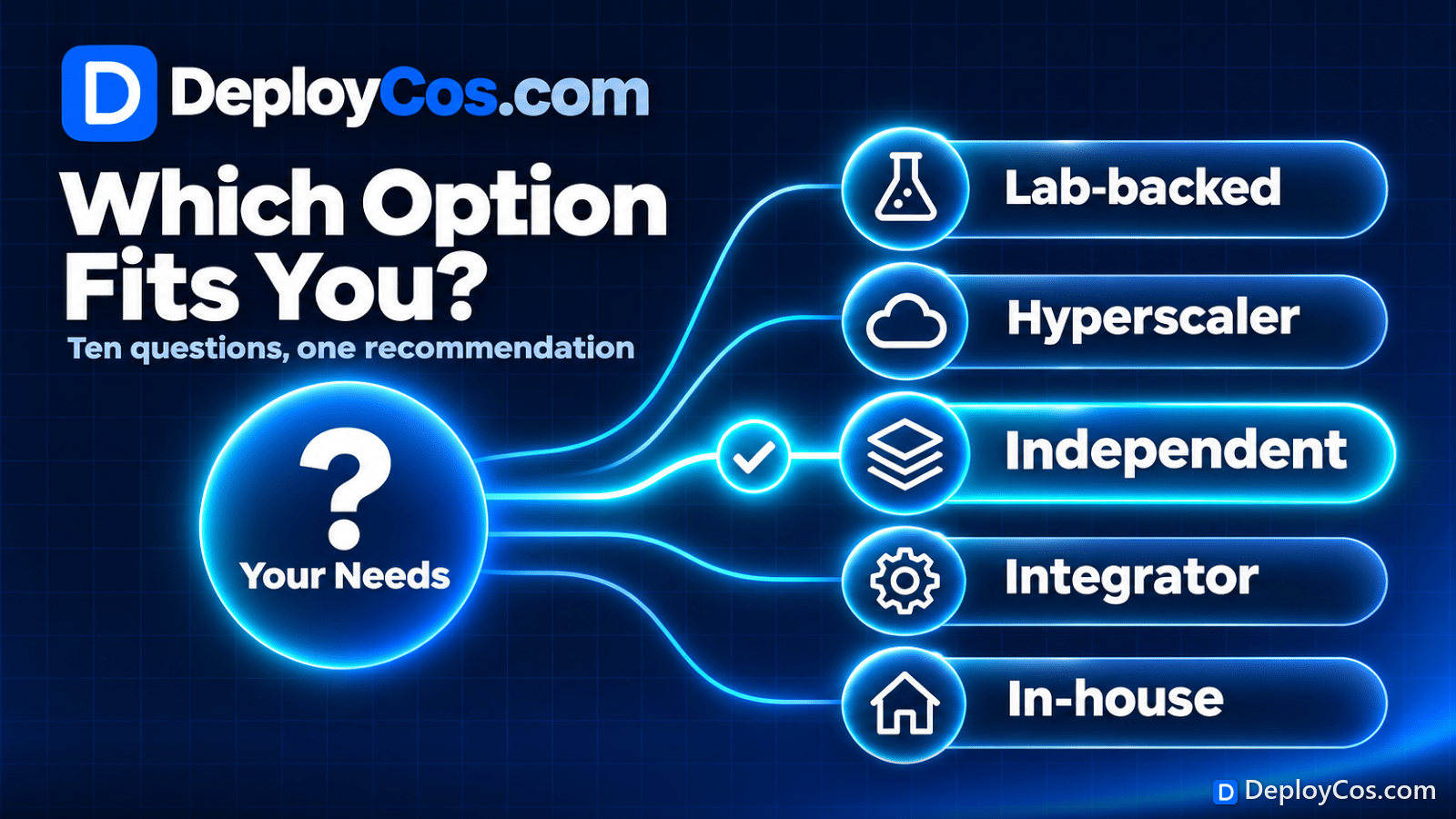
DeployCo, Hyperscaler, Integrator or In-House? A 10-Question Decision Tool
Answer ten questions about your timeline, team, model stance, cloud, data, scope, budget and ownership plans. The tool recommends one of five routes - a lab-backed DeployCo, a hyperscaler FDE unit, an independent AI-native firm, a systems integrator or an in-house build - and shows why. Every weight is published below, so you can see exactly how the answer was reached.
The questions
Pick one answer per question, then press Show my result. Nothing you choose leaves your browser.
The five routes
| Route | Examples | Main trade-off |
|---|---|---|
| Lab-backed DeployCo | OpenAI Deployment Company, Ode with Anthropic | Frontier access and speed, against model lock-in |
| Hyperscaler FDE unit | AWS, Microsoft Frontier Company, Google Cloud partners | Multi-model and platform credits, against pull toward one cloud |
| Independent AI-native firm | Palantir-style firms such as Distyl | Model neutrality, against smaller balance sheets |
| Systems integrator | Accenture, Deloitte and peers | Breadth and relationships, against fewer engineers per dollar |
| In-house build | Your own engineers | Control and retained skills, against time to hire |
Compare the providers inside each route in the comparison matrix.
How the scoring works
Each answer adds or subtracts points for each route, from -2 (a poor fit) to +2 (a strong fit). The route with the highest total is the recommendation, and any answer that gave it +2 is listed as a reason. The weights are judgments based on the providers' published delivery models, pricing and model policies (see the matrix for the sources). They are a starting point for a conversation, not procurement advice.
| Answer | Lab-backed DeployCo | Hyperscaler FDE unit | Independent AI-native firm | Systems integrator or consultancy | Build in-house |
|---|---|---|---|---|---|
| Q1a: Within 3 months | +2 | +2 | +2 | 0 | -2 |
| Q1b: Within 6 to 12 months | +1 | +1 | +1 | +1 | +1 |
| Q1c: No hard deadline; we want to build capability | -1 | 0 | 0 | 0 | +2 |
| Q2a: No, or very few | +2 | +1 | +2 | +1 | -2 |
| Q2b: Some, but not enough or not experienced with AI | +1 | +1 | +1 | 0 | +1 |
| Q2c: Yes, a capable team | 0 | 0 | -1 | -1 | +2 |
| Q3a: Fine, if it is the best model for the job | +2 | 0 | 0 | 0 | 0 |
| Q3b: We want a preferred model with freedom to switch | 0 | +2 | +1 | +1 | +1 |
| Q3c: We must stay model-neutral | -2 | +1 | +2 | +1 | +2 |
| Q4a: Mostly one of AWS, Azure or Google Cloud | 0 | +2 | 0 | 0 | 0 |
| Q4b: Several clouds, or on-premises | 0 | -1 | +1 | +1 | +1 |
| Q4c: We use Palantir Foundry or another data platform heavily | 0 | 0 | +2 | 0 | 0 |
| Q5a: Highly regulated (health, finance, government) | 0 | +1 | +1 | +1 | +1 |
| Q5b: Confidential but not regulated | +1 | +1 | +1 | 0 | 0 |
| Q5c: Low sensitivity | +1 | 0 | 0 | 0 | 0 |
| Q6a: One or two bounded workflows | +1 | +1 | +2 | -1 | +1 |
| Q6b: Several workflows across a business unit | +2 | +1 | +1 | +1 | 0 |
| Q6c: Company-wide transformation with process redesign | 0 | 0 | 0 | +2 | -1 |
| Q7a: Under $250,000 | -1 | +1 | 0 | -1 | +1 |
| Q7b: $250,000 to $2,000,000 | +1 | +1 | +2 | 0 | +1 |
| Q7c: Over $2,000,000 | +2 | +1 | +1 | +2 | +1 |
| Q8a: Fixed price or tied to outcomes | 0 | +2 | +1 | 0 | 0 |
| Q8b: Time and materials is fine | +1 | 0 | +1 | +2 | 0 |
| Q8c: Salaries and our own tools only | -1 | -1 | -1 | -1 | +2 |
| Q9a: Our own team | 0 | +1 | +1 | 0 | +2 |
| Q9b: The partner, as a managed service | +1 | 0 | +1 | +2 | -2 |
| Q9c: Undecided | 0 | 0 | 0 | 0 | 0 |
| Q10a: A lot: we want early access to new models and features | +2 | 0 | 0 | 0 | 0 |
| Q10b: Some: proven capabilities are enough | 0 | +1 | +1 | +1 | +1 |
| Q10c: Not at all: reliability matters more | -1 | +1 | +1 | +1 | +1 |
Frequently asked questions
Should a large enterprise always use a systems integrator?
No. Integrators are strongest on company-wide change programs. For one or two bounded workflows, an embedded engineering team usually ships faster. Many enterprises use both: an integrator for the program and a DeployCo or hyperscaler unit for the build.
What if two routes tie?
Run a paid diagnostic with one provider from each and compare the ranked workflow lists and prices they return. Competing two provider types is good practice anyway.
Is building in-house ever the fastest option?
Only when you already have engineers who have shipped AI systems to production. Otherwise hiring takes months, which is why the tool penalizes in-house builds when the deadline is under three months.