AI Deployment ROI Calculator: Payback and 3-Year Value of a DeployCo vs an Internal Build
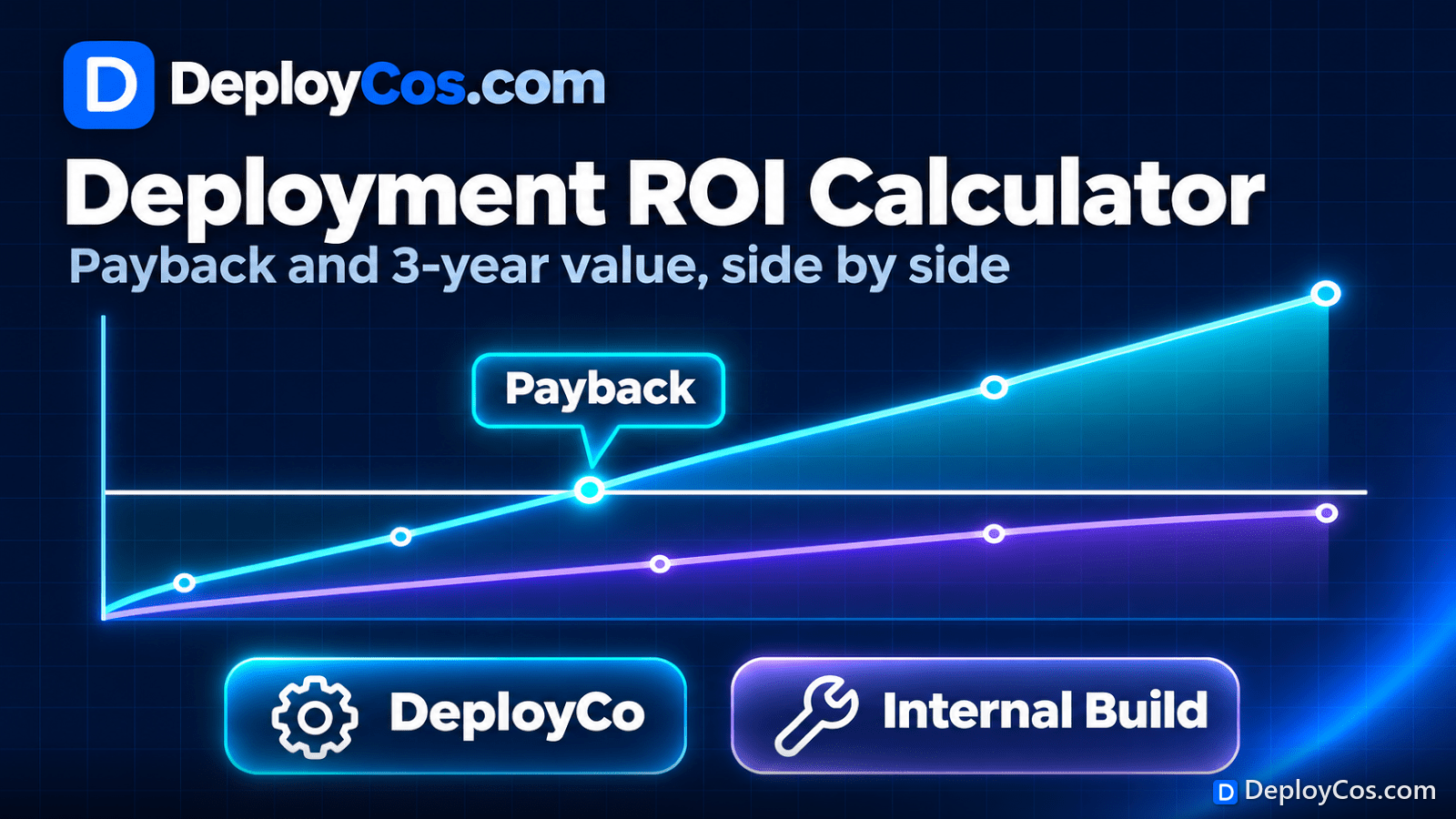
Enter one workflow's volume, the time it takes today and what an engagement would cost. The calculator returns the payback month, 3-year net present value and cost per automated task for a DeployCo engagement and an internal build, side by side. Every default is a sourced range or a labeled assumption; replace them with your own numbers.
The calculator
Results update as you type. Nothing you enter leaves your browser.
How the model works
- Savings = tasks per month x minutes per task / 60 x loaded hourly cost x share of time saved. Savings start the month after the system reaches production.
- Risk: savings are multiplied by the chance the workflow reaches measurable value, so a likely failure counts against the option.
- DeployCo cost = engineers x weeks x 40 hours x hourly rate, paid up front, plus model and infrastructure cost per task and an annual support fee after launch.
- Internal cost = build team x loaded annual cost for the months to launch, plus model and infrastructure cost per task and the engineers kept on to run it.
- Net present value discounts each month's net cash flow over 36 months at your discount rate. Payback is the first month cumulative cash flow turns positive.
It is a deliberately simple model: one workflow, savings at full adoption from launch, no tax effects. Use it to compare options and to test which assumptions matter, then ask vendors to price against your numbers. The spreadsheet version has the same inputs.
Where the defaults come from
| Default | Value | Basis |
|---|---|---|
| Loaded cost per staff hour | $95 (range $60 to $130) | Software developer median wage of $65.38 per hour (BLS, May 2025) times about 1.43 for benefits, from benefits at about 30% of private-industry compensation12 |
| Share of task time saved | 14% (range 5% to 35%) | 14% more issues resolved per hour, and 35% for the least experienced workers, in a study of 5,179 support agents3; about 5.4% of work hours saved among generative AI users in a Federal Reserve survey4 |
| Embedded engineers and length | 5 engineers, 12 weeks | AWS describes pods of five or six engineers on engagements of about 45 days5 |
| Rate per engineer hour | $250 (range $150 to $500) | Published AI consulting rate surveys; vendor-published, not audited6 |
| Chance of measurable value | 67% partner-led, 33% internal | MIT NANDA's "GenAI Divide" report, which found purchased or partner-led tools succeeded about twice as often as internal builds; its methods are disputed7 |
| Internal engineer cost | $250,000 a year | About $175,000 median posted base pay for the role, times about 1.43 for benefits (see FDE salary benchmark) |
| Model and infrastructure cost per task | $0.05 | About 10,000 tokens per task at $5 per million tokens; frontier list prices range widely, so use your own measured figure |
| Ramp, support fee, discount rate | 3 or 6 months; $120,000; 10% | Assumptions. No audited figure exists; ask each vendor and use your finance team's rate |
Frequently asked questions
Why does the default case show such a modest return?
Because the defaults use measured averages, not vendor case studies. A 14% time saving on one workflow is realistic for a first deployment. Returns grow with volume, with a larger saving on a well-chosen workflow and with more workflows on the same foundation; try changing those inputs.
Is the 95% AI pilot failure figure built in?
No. The MIT NANDA report's widely quoted 95% refers to pilots showing no measurable profit-and-loss impact, a contested definition. The calculator uses the same report's comparison of partner-led and internal success rates instead, and lets you change both.
Should I trust a vendor's ROI figure?
Treat it as a claim. Ask for the baseline, the measured result, the volume and the cost per task, then enter those numbers here. The evaluation checklist lists what to ask.
References
- U.S. Bureau of Labor Statistics, Occupational Employment and Wages, Software Developers (15-1252), May 2025. bls.gov
- U.S. Bureau of Labor Statistics, Employer Costs for Employee Compensation, June 2026 (released 09-09-2026). bls.gov
- Brynjolfsson, Li and Raymond, "Generative AI at Work," NBER Working Paper 31161. nber.org
- Federal Reserve Bank of St. Louis, "The Impact of Generative AI on Work Productivity," 02-2025. stlouisfed.org
- The Next Web, "AWS commits $1bn to forward deployed engineers for enterprise AI," 06-30-2026. thenextweb.com
- Layer3 Labs, "AI consulting rates and pricing," updated 06-17-2026. layer3labs.io
- Fortune, "MIT report: 95% of generative AI pilots at companies are failing," 08-18-2025. fortune.com