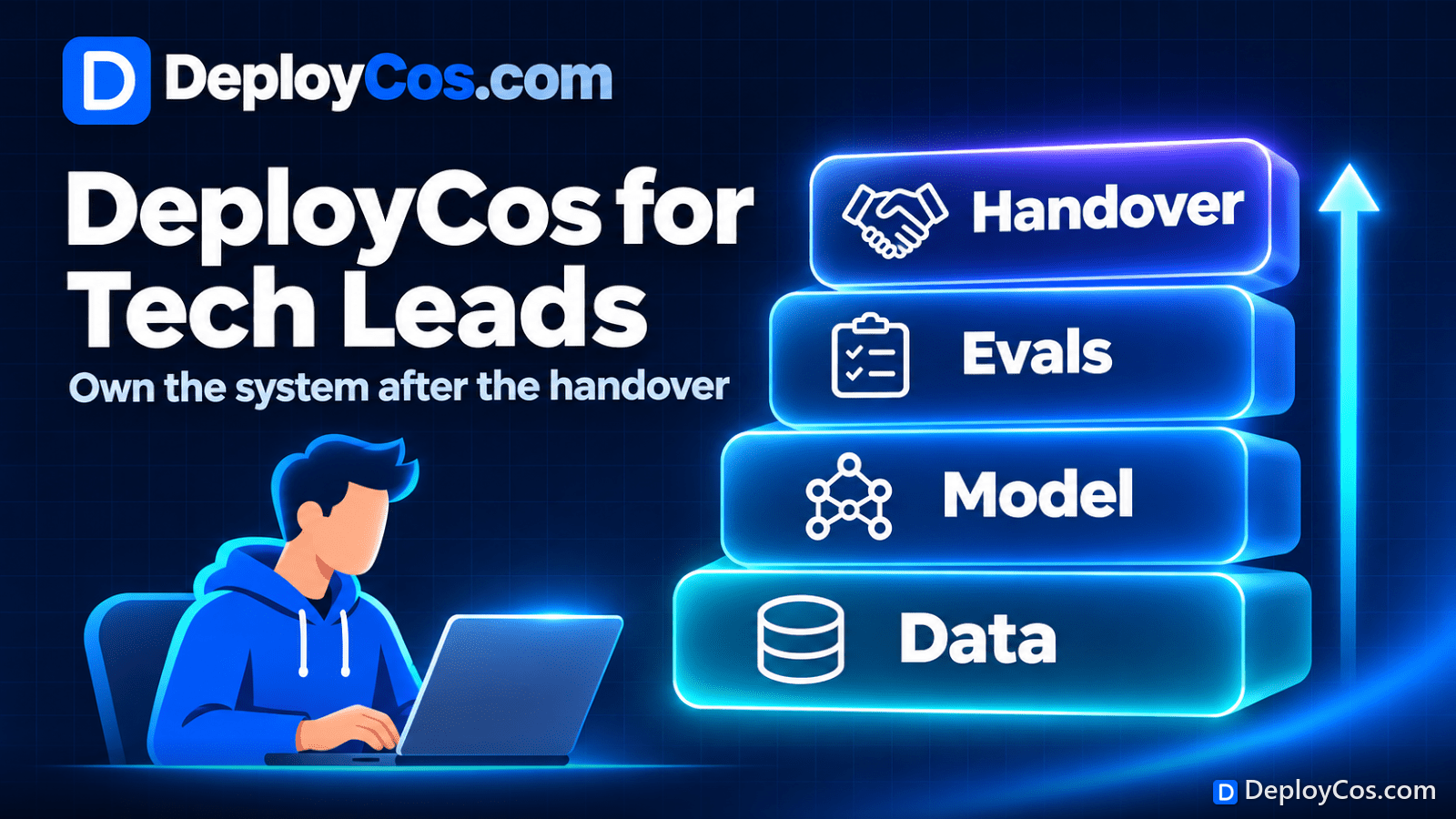
DeployCos for Tech Leads: Architecture, Evaluations and Owning the System After Handover
The tech lead is the person left holding the system when the embedded engineers leave. The verdict: insist that the provider works through your interfaces, builds an evaluation suite you can run yourself, logs every action to your tools and pairs with your engineers from week one. If those four things are in place, a DeployCo engagement leaves you with a better platform; if not, it leaves you with a black box.
What good looks like at handover
| Layer | You should own | Red flag |
|---|---|---|
| Integration | Connectors through supported APIs to your systems of record | Screen-scraping; integration deferred to "phase two" |
| Model layer | A model gateway or abstraction that can switch providers | Model calls hard-coded to one vendor's SDK everywhere |
| Evaluations | A fixed test set from real cases, scored automatically in CI | "Accuracy" quoted with no denominator |
| Guardrails | An approval policy for consequential actions, enforced in code | Autonomy granted by default |
| Observability | Traces of every model and tool call in your logging stack | Logs only in the vendor's console |
| Operations | A runbook, alerts and an on-call owner on your side | Support only through the vendor |
These follow the five evaluation criteria in How to Evaluate a DeployCo: production accuracy, integration depth, operating cost, governance and business ROI.
Working with embedded engineers
- Access first. Have credentials, a non-production environment and data samples ready before kickoff. Every week of waiting is paid for.
- Pair from week one. Put one of your engineers on the provider's team full time. Knowledge transfer at the end does not work.
- Review code like your own. Same repositories, same pull-request reviews, same release path.
- Ask for the model comparison. A head-to-head evaluation of at least two models on your task, recorded in an architecture decision record.
- Track cost per task from the first prototype. Newer reasoning models can cost more per task on hard problems, so measure it rather than assume it.
Who these engineers are and how they work: Forward Deployed Engineers and How DeployCos Work.
Tools and downloads for tech leads
Run the readiness checklist with your security and data owners before the first vendor meeting.
DeployCo Vendor Scorecard
Weighted scorecard for comparing lab-backed, hyperscaler, independent and consulting options. Weights are editable and the totals recalculate.
Engagement KPI Dashboard
Monthly tracker for adoption, cycle time, cost per task, accuracy, escalation rate and engineer hours per workflow.
RFP and RFI Question Bank
60 questions to send AI deployment vendors, grouped by team, diagnostic, workflow, security, IP and data, pricing and exit.
First 90 Days Playbook
Week-by-week plan for the buyer side of a first engagement, from kickoff to the day-90 review.
Cheat Sheet: First-Meeting Questions
The fifteen questions to ask in the first vendor meeting, and what a good answer sounds like.
Questions tech leads ask
Will the provider use our stack or theirs?
It depends on the type. Hyperscaler units build on their cloud, Palantir builds on Foundry and AIP, and lab-backed DeployCos build on their owner's models. Independents are the most flexible. Agree the stack in the statement of work.
How big should the evaluation set be?
Start with at least 100 real examples with known right answers, drawn from the actual workflow and refreshed regularly. The score that clears production should be written down before the build.
Who is on call after launch?
Decide before launch. If it is the provider, price production support in the contract; if it is your team, the runbook and alerts must exist before go-live.
Can we keep the code if we change vendors?
Only if the contract says you own it and the code lives in your repositories. Make both true from day one.
What should we build ourselves?
The shared foundations every workflow needs: identity and access, logging, the evaluation framework and the model gateway. Let providers build workflows on top of them.